Kale, Compost and Condoms

What has sex got to do with revolution, anyway?

   “…the students are still out there, that’s what I have heard…They’re living and making love right on the barricades.”
   “…Well, this is about freedom, isn’t it?…Doesn’t that include free love…?”
   “Is it really about free love?…They said it was about freedom of speech and better education.”  
   “It’s about changing what we value…And that should include free love!”

So runs a conversation among students gathered in a Paris cafe in A Time to Cast Away Stones*. They recognize that the May Revolution is more than a political action to shake off an aging and fascist president. It is a social and cultural revolution as intense and important as the political fracas – in a society undergoing a complete change of values.

From one month in 1968 to the approach of one year from 2011– marks the remarkable difference between the May Revolution and the Occupy Movement. This accomplishment and the spread of new ideas across the nation didn’t just “happen.” Both “revolutions” were thwarted by police (and in France, the army!), political forces, a right wing media, and plenty of skeptics in the center. But French students on the barricades were battling something just plain sinister—their own wish to toss off moral and social constraints in a way that damaged their own health and safety. Conditions ranging from rampant sexually-transmitted disease, lack of medical care, filthy living conditions and sheer exhaustion eventually took their toll in 1968.
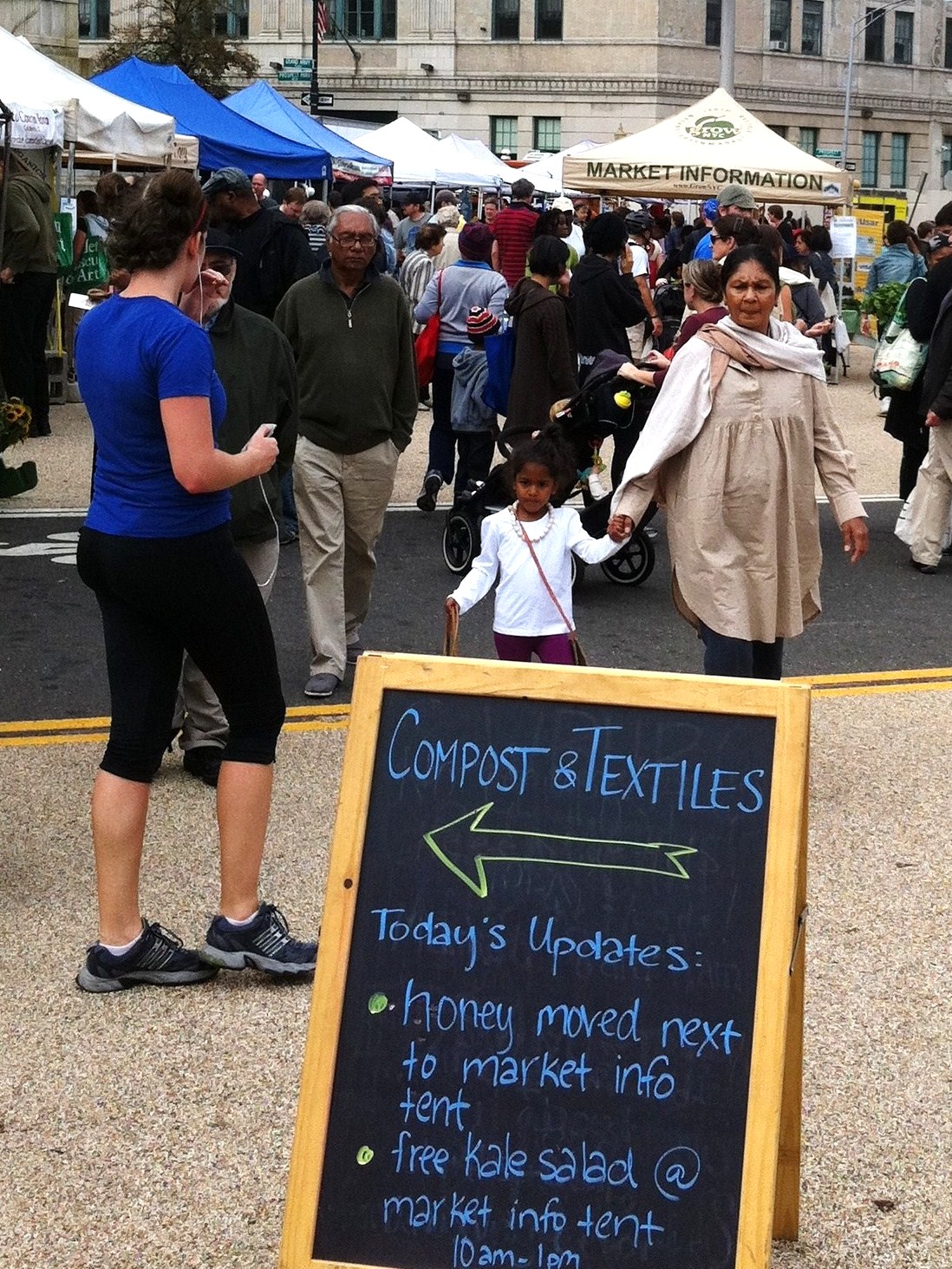
Sign directing Occupiers to Compost & Textiles. Today’s updates: honey moved to market info tent and free kale salad.

In 2011, 2012, the freedoms of young and old have turned the responsibility for healthful living—and the dangers of ignoring that responsibility—back to individuals and their communities. In New York, if not in every “occupied” city, the Movement’s response to basic human needs is directly related to the sustainability of the project. That is why, in the midst of what could be chaos, there is so much emphasis on order and mutual aid.

Spilling blood for the revolution – their way

Now, I admit I don’t have first-hand knowledge of Occupier sexual activities. What I do know is how it felt to be young and in Paris in 1968. Several authors, like James Jones (gained fame by writing the World War II  romance, From Here to Eternity), expressed shock and disgust when writing about the new freedom and unrestrained license of the young Parisian revolutionaries. It’s true that some students swapped sexual partners as easily as nibbles of croissant. And I agree that the result was a whole lot of high times – and mixed feelings, hurt feelings, and the verified and oft-noted STDs.

To approach that situation differently, in A Time to Cast Away Stones I chose to emphasize the moral straitjacket that had constrained teens and college students—up until the May Revolution. One of the original complaints of student protesters was the rule against men and women students visiting in campus dormitory rooms. Their free speech on this very topic was denied by the college administration. Bourgeois girls (and some boys!) were expected to remain virgins until marriage. By the 1960s, French morality came not so much from the church as from expectations of both parents and peers. The fact that secret trysts meant that there were increasingly few young virgins around is besides the point. Secret was not free – and it was demeaning, like the French educational system.

 Just as students paid the price of “revolution” on the barricades, they paid the price (okay, here comes the “spilled blood” part) by breaking free from their neat and clean and morally upright bourgeois lives.

This was not as easy or jolly as it sounds. In A Time to Cast Away Stones, the protagonist, Jeanette, feels confused and less sure about the social revolution than she is about the political revolution. But thinking she has found a satisfactory way of viewing the startling changes all around her, she rants to her Czech boyfriend:

“Teo, listen…All the trouble in the world seemed random before, but now I can see it’s connected. Paris is on fire, Vietnam drags on, Moscow threatens the Czechs, and students everywhere reject their governments. So now we all swear and dress like slobs and throw off religion and morals and…and I lost my virginity last night…” [She] stopped, breathless, tears in [her] eyes.

Teo was laughing softly and shaking his head. “Well, I’m glad we can love each other with all this trouble in the world,” he said. But…that’s a lot of connections…”

Occupiers have benefitted and suffered from the sexual revolution. Even in families that stress abstinence, no one in the Western world will ever think of this topic in quite the same way as we did when I was growing up. We have TV shows that teach more to a five-year-old than I knew until I was (yikes!) fourteen. And we’ve lived through the age of AIDS. Occupiers are free – but sadder and wiser than the 1968 revolutionaries.

The morality of community

Sex wasn’t the only drag on those students, and Occupiers have proven themselves wiser in other areas as well. May Revolutionaries were too pumped up to sleep much. And no one thought about a next meal, let alone food safety and sanitation. In the Occupy Movement, it’s been a given from the beginning that creating Working and Affinity Groups to plan the next protest action is vital—but so are the basic needs of the protesters.

In 1968, after battles, revolutionaries suffered from a lack of medical care for the sick and wounded. Threatened with arrest, many preferred to languish on the sofas of friends’ apartments or later, on classroom or hallway floors at the Sorbonne. This year in NYC, trained Affinity Group Medics (AGMs) provide medical attention to protesters. All affinity groups are encouraged to consider having at least two trained medics.

These and many other Working Groups provide sustainability—but also a model of community and a healthy and moral lifestyle: The People’s Kitchen (feed the protesters), Tea & Herbal Medicine (healthy and balanced diet), Restricted Diets (respect differences), Sanitation (keep clean, or try—and compost, recycle…), Occupy Yoga (keep up your strength), Meditation (acknowledge mind-body health), Occupy Library (education and mental stimulation), and Healthcare for the 99% (donated medical supplies and doctor services).

*You can pick up a copy of A Time to Cast Away Stones (Sand Hill Review Press), set during the 1968 Berkeley antiwar protests and French May Revolution, in June from Amazon in print or Kindle, or your favorite bookstore.

Posted in Uncategorized | Tagged , , , , | Leave a comment

About the About

I’m new to blogging, but that is a poor excuse. I apologize. Next time I’ll read the “Tips” for beginners before I begin.

Now the “About” is no longer a mere brief bio piece. Re-visit the all-new “About” section (click the About on the side menu) to learn about why I am – actually – incredibly qualified to write about the May Revolution in 1968 Paris – and how it compares to the Occupy Movement. How did I come to write about this topic? What are my experiences and research?

And why do I want to hear from you? To find out if you are surprised, pleased, object to, disagree with, or have any other large and small, emotional or cerebral, reactions to my high hopes – for positive results from Occupy.

Next topic: What have compost, kale and condoms to do with Revolution?

Posted in Uncategorized | Tagged , | Leave a comment

About

What kinds of circumstances, arguments or earth-shaking events would convince you to show up for a political protest? Would you have to know someone who was going? Or would you follow someone you wish you knew, or wanted to know better?

Or if you’ve already been out with Occupy – or the Tea Party! – what drove you to take action?

A Time to Cast Away Stones, my novel set in Berkeley and Paris in 1968, explores these questions. During my years of research and writing, I never lost sight of my obsession (admitted!) with the topic. What would convince a person previously disinterested in politics – or cynical, wishy-washy, self-interested – or conformist, ambitious – or shy, scared, spooked by crowds – to demonstrate? Why do they come out to observe, let alone stay and carry a picket sign and shout and march?

For years, I sat on campus lawns, remembering, and in libraries, at microfiche machines, and later in front of computer screens, trying to imagine what would make shy, insecure Janet Magill and her cynical, nerdy childhood sweetheart Aaron Becker take to the streets.

Janet Magill looks back from the lofty heights of a years-later Prologue, and complains that the myth of the ‘60s has persisted, promoted by the media for its entertainment value. “…miraculously,” she says of college student stereotypes, “they had acquired the ability to analyze every American blemish as if they’d earned PhDs in sociology. And courage! What bugged me most was the courage they all supposedly had: to change the way they looked, to expose themselves to loss of family and friendships, to attack and be assaulted physically, to risk everything for their ideals.”

So, what has this got to do with the 1968 May Revolution? Simply, that was my vehicle for exploring the topic, but in the past year, it has become much more.

Through this blog, I set out to compare the 1968 May Revolution in Paris with the Occupy Movement. I find there are amazing similarities, on so many levels! Things happened in France in 1968 that haven’t happened since, but are happening in cities all over our country, right now. I’ve been reading other blogs about it, but I see only descriptions of what happened then. Readers are supposed to infer how this compares to the Occupy Movement. I intend to go through specific aspects of the movements—the roles of intergenerational participation, health, media, leadership, organization, etc.—and compare. 

The irony is that all those years I spent focused on the past, there was so little protest. We had brief forays in Seattle, and abroad, protests skirted alongside of wars, civil and otherwise. But now that I’m blogging, I find myself focused on the present and the future. With the Occupy Movement, the world has shifted on its axis once again in my lifetime!

So, please, read on and let me know. Have my experiences and research given me some insights into the mind of the protester – and some reason to hope that the Occupy Movement might be sustained and effective?

For more about A Time to Cast Away Stones (Sand Hill Review Press) and the history behind it, please visit my website at http://www.elisefmiller.com. My Facebook page is at http://www.facebook.com/profile.php?id=100003495436635.

And I would love to hear from you! You can email me at elisefmiller68@gmail.com

Posted in Uncategorized | Leave a comment

The Generation Connection

Generations assembling at Zuccotti Park,
October 2011.

The Occupy Movement has sparked a national brainstorming. It began with effective naming, slogans, high energy, and an endless conversation. Talk and more talk, all day and into exhilarating, sleepless nights. The Occupy Movement and the 1968 French May Revolution share quests for a public voice, shared “horizontal” leadership, and space for open-ended, open-minded debates.

One of the major similarities between events in 1968 Paris and 2011-12 NYC is the inter-generational nature of the protests. In the spring of 1968, I was in Paris, studying French and art and looking forward to celebrating my twenty-first birthday in the City of Light. Then the talk invaded our boarding house, where several high school and college students from the French provinces and other countries gathered around a huge oak dining room table to discuss their role, if any, in the Events of May. My French language was still limited, but I understood enough to realize that such a discussion could never have taken place in the America I had left behind. American adults in the 1960s were largely dismissive of student politics.

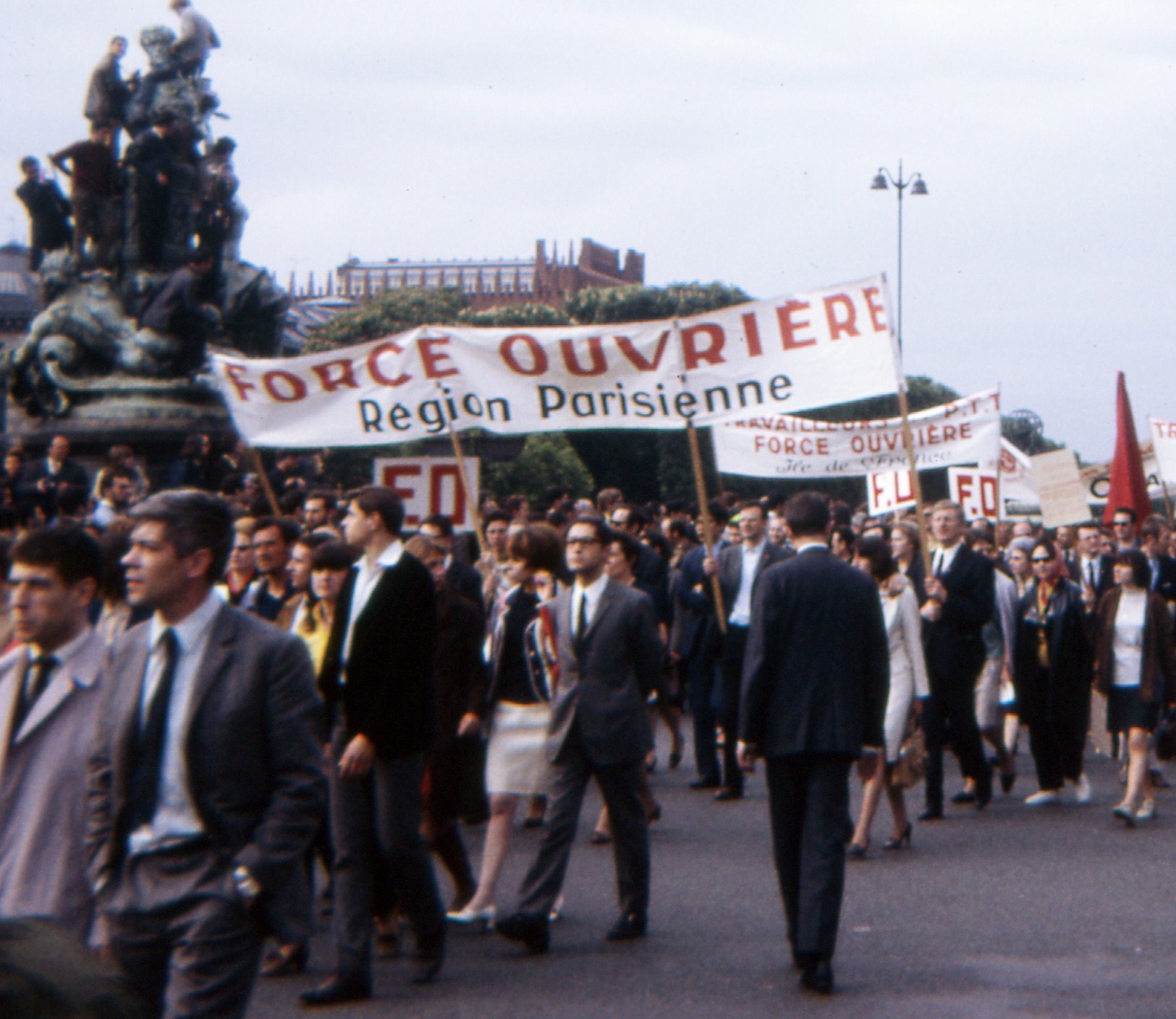
Workers and the French middle class (“bourgeoisie”) supported the student protests during a million-strong demonstration, Paris, May 1968.

Lawrence Ferlinghetti of San Francisco’s City Lights Books and beat poet fame wrote Love in the Days of Rage, a master work of fiction describing the 1968 Parisian “Events of May.” His American protaganist/observer was a 30-year-old American woman. I wondered how different the Revolution would have looked if she had been eighteen instead of thirty? And what if her boyfriend had been a twenty-one and a hopeful idealist instead of a seasoned, hardened, 30-something anarchist? Like Ferlinghetti, James Jones, the author of the quintessential World War II novel, From Here to Eternity, tried his hand at the May Revolution. But again, Jones’ narrator and protagonist in The Merry Month of May was far beyond his student years—a cynical, jaded, 49-year-old intellectual.

My novel on the subject, A Time to Cast Away Stones (available June 1) is written from the viewpoint of the generation that started and exemplified the May Revolution. If the view is from youth, I reasoned, there are years ahead and hope and belief that a better world will come to pass, and that what they do will be worthwhile. I have spent my adult life as a mother, teacher and university administrator, first at San Diego State and later at Stanford. Thanks to these close connections, my sympathy has surpassed my cynicism on issue after issue.

This is democracy – whether American or French. Please note the American flag at the center of this Occupy crowd in NYC (double click on the image to enlarge).

The Occupy Movement has proved to be far more sustainable, scalable, and effective than the May Revolution. If you are sick of Occupy, but think that anyway, it’s going away, watch the energy still there at: http://www.youtube.com/watch?v=nF1B3l2lu1s&feature=youtu.be. Focus on the many generations of faces and the signs: “20% of American children live in poverty, changes needed” and “All of our grievances are connected.”

I am blessed with the hope of youth—now transmitted to a felicitous mix of generations—that the Occupy Movement weaves a powerful narrative into the fabric of American history.

Elise Frances Miller’s novel, A Time to Cast Away Stones, is set during the 1968 Berkeley antiwar protests and French May Revolution. Available June 1 from Sand Hill Review Press. Visit http://www.elisefmiller.com for more about the history of the May Revolution.

Posted in Uncategorized | Tagged , , , , , | 3 Comments

Another slow burn? Comparing Occupy to the 1968 May Revolution

This is May Day, 2012. As the Occupy Movement seeks to re-boost the powerful engine that has all but sputtered to a halt during the winter, I am reminded that the 1968 May Revolution in Paris didn’t achieve its goals until a year later. That’s when General Charles de Gaulle was voted out of office. No one in the spring of 1968 could have predicted that anything short of death could have toppled the venerable national icon of World War II and the Algerian War, the hero of the bourgeousie, aka the powerful and conservative French middle class. But in 1969, he was gone—and many have credited the Events of May – which paralyzed Paris with battles and the entire French nation with strikes – with de Gaulle’s downfall.

Revolution is the spark, but the fire, in a democracy, is a slow burn. It must spread with white heat and ignite other fires throughout this large nation.

Both Occupy and the May Revolution sought to regain an acknowledged “voice” where essential issues are concerned. Voice, and thus power, and so “liberty” in the sense of a government released from plutocracy to be “by and for the people.” That’s all the people.

As I am transported back to 1968, I remember shouting matches and lucid conversations, pitched battles and yet, thousands marching in such determined, eerie quiet that we heard footfalls on the paving stones. Few Americans under 50 have even heard of the incredible events that I witnessed in France when I was studying abroad in 1968. Yet the May Revolution was the first student-worker-middle class alliance and “revolution” in an advanced, Western, capitalist democracy. Over ten million French citizens were involved in a general strike, tens of thousands battled police, and the army was called out.

In comparing these two revolutions, I have lots to blog about! I’ve seen descriptions of the May Revolution in several online articles, but not specific aspects compared:

-How health issues scuttled the Revolution – then, not now
-How the original organization changed the outcome
-Concepts of leadership
-The interplay of generations
-Forms of liberty
-And the greater revolution in technology, arts and culture.

Look for these topics in upcoming blogs! Meanwhile, I’d love to hear from you! Were you there in Paris in 1968? Were you in Europe? NYC? Berkeley? Vietnam? And how have your experiences shaped your opinions about the Occupy Movement!?

Elise Frances Miller’s novel, A Time to Cast Away Stones, is set during the 1968 Berkeley antiwar protests and French May Revolution. Available June 1 from Sand Hill Review Press. Visit http://www.elisefmiller.com for more about the history of the May Revolution. 

Posted in Uncategorized | Tagged , | 1 Comment

Hello world!

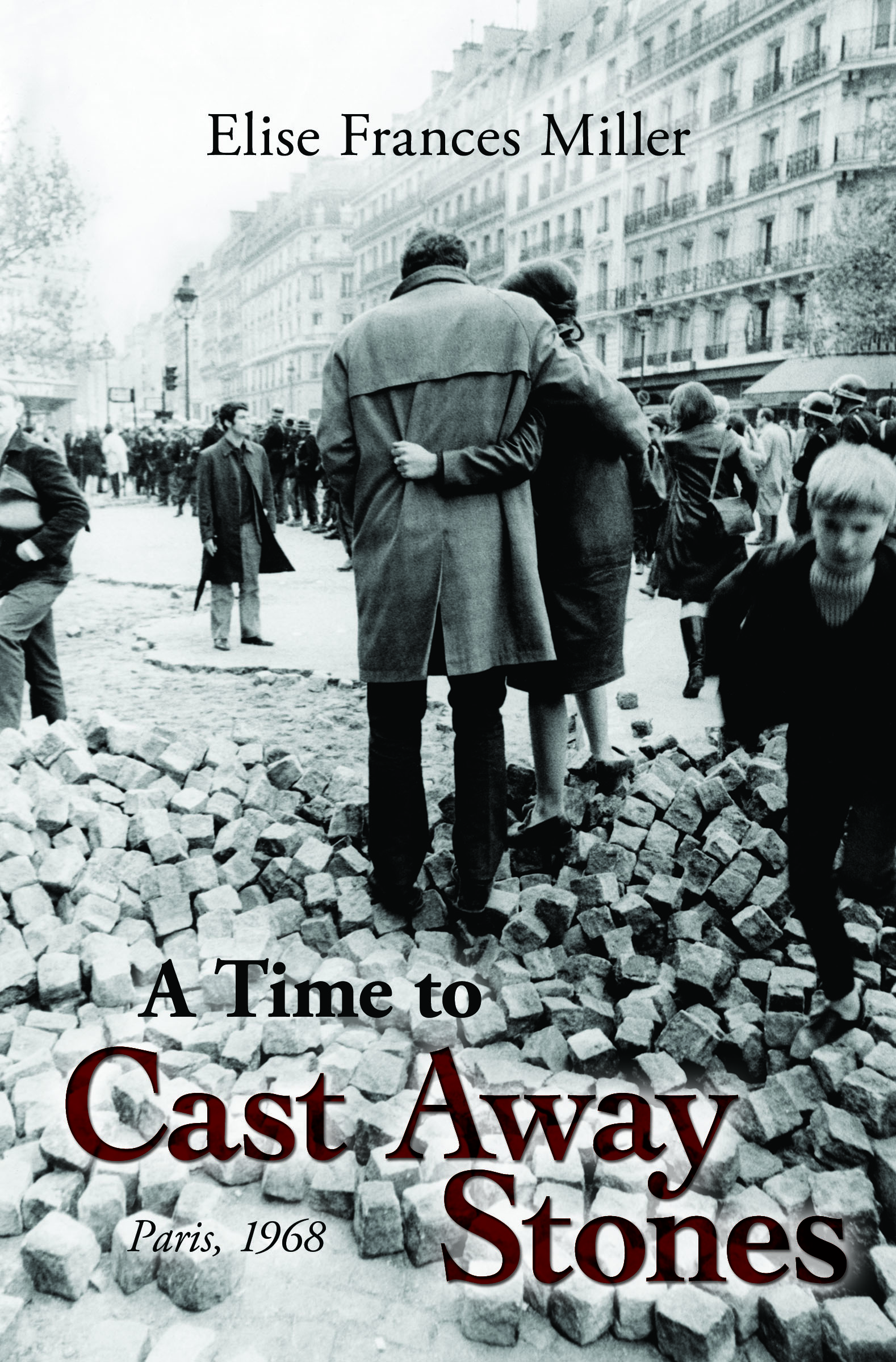
Welcome to STONES – the Blog! Like its title, expressed through the image of the Parisian pavés,  I hope to work my way up to a hard and durable form of truth. I need your help! How can truth be arrived at without the hard – as in “difficult” – conversations!

In Paris, 1968, the pavés were pulled up by the students and other demonstrators to build their barricades against attacks of both police and the French army. After the May Revolution, the government cemented over these paving stones, hoping they’d seen the back of revolution in their nation.

For a great story, and to learn how the year 1968 changed lives, read the other “Stones” – A Time to Cast Away Stones – my novel set during the 1968 Berkeley antiwar protests and the French May Revolution (Sand Hill Review Press). Available June 1 in print and Kindle from amazon.com and from bookstores through Ingram.

Posted in Uncategorized | 1 Comment