Granny’s Baby Grand – From the Winter of My Discontent to the Joy of the Winter Concert

grannys-piano

The highlight of our recent trip to Seattle was our granddaughter Rina’s “Winter Concert.” She played a melodic classical piece called “First Flight” by Lisa Moore, and she played it with feeling and to perfection. In my day, this would have been called a “recital,” but really, this was a true concert. Rina is eight, and has been taking piano for only a year, but there she was, up on a real stage in a proper concert hall, appearing poised and dressed for the part, along with her fellow students at Kristina Lee Music.

But this is not a blog about Rina. This little story is about her piano, and about Ann, Tula, Elise and Rina, the players of that piano.  When on the morning of the concert, Rina gave me her “preview” of the piece she would play in public that afternoon, she had a big smile on her face. I mean a grand, sparkling smile. And that was when she said, “Granny would be proud of me!” as if it were Granny sitting there for the preview, not me, her Grandma.

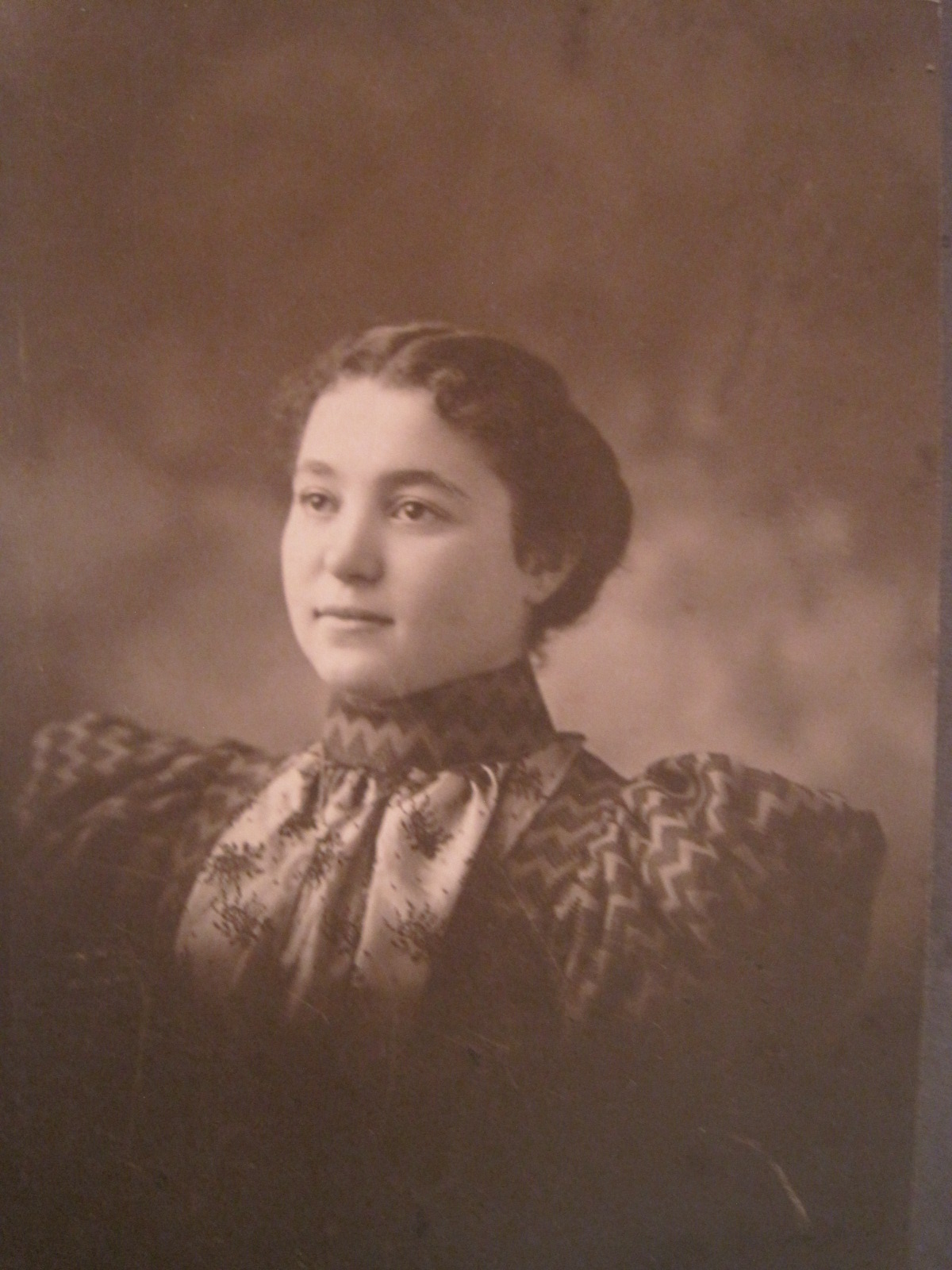
In fact, Rina never knew “Granny,” my mother Tula Ruth Greenberg Friedman, who passed away at 93, three years before Rina was born. But what she knows about is the history of the piano she plays, and how Tula felt about music and the instrument.
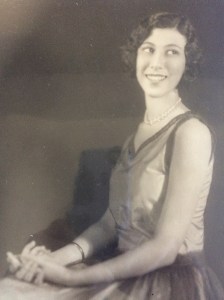
Tula at 17, 1929

Tula at 17, 1929

My own Grandmother Ann, Tula’s mother, studied at the Kansas City Conservatory of Music and sang in the chorus of the Kansas City Opera. She purchased that Kroeger baby grand piano in 1915. Tula Ruth, as she was called in midwest fashion, grew up learning to accompany her mother’s soprano voice. My mother could sight read any piece as if she’d been practicing for days! And decades later, when we kids had a holiday, a dance practice, or a party that called for song, or the grownups had a party or a PTA show, it was always Tula they called on for rehearsals, performances, and just plain fun. All on Grandmother Ann’s baby grand, which by then graced our living room in Los Angeles.
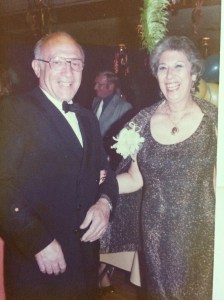
Tula and my dad, George,on their 35th anniversary, New Years Eve, 1973

Tula and my dad, George,on their 35th anniversary, New Years Eve, 1973

But Tula didn’t just play, she also sang, both solo and in choruses. I have a tape of her singing “There’s a Song in My Heart” and operatic “art songs” in a trained, operatic voice in the early 50s, then later in the decade switching to a more jazzy voice and rhythms for “Alexander’s Ragtime Band,” “Cockeyed Optimist” and “Side by Side.” The jazz singer still sounded like her, but with an entirely different, more “modern” inflection. She compared her new style to the way Frank Sinatra had aligned his 1940s tenor (think Bing Crosby) to suit the times during the 50s.

On that tape, Tula also displayed her talents when she did practice and perfect a piece – the difficult Roger Williams arrangement of Autumn Leaves, popular in those days.

Beginning at aged 4, I was given lessons on that same piano. Now comes the heartbreaker. No way would I ever accompany my mother as she did hers. I had no talent for it. My sense of rhythm was there, and I could sing on tune. But I struggled with reading music. I hated to practice. I hated being alone in the living room, failing over and over again at that monstrous piano. We switched teachers several times over the next nine years. 9. Was I clear about that? When I was a teenager, a psychologist informed my mother that although I lacked nothing in intellect, my one low score on the IQ test was “eye-hand” coordination. Did I mention I was a washout on the playground, too? I could have kissed that aging psychologist! At last, I had a real reason that I could never be what my mother wanted me to be.

But Tula’s hopes revived when my son, Rina’s father Corey, took up the guitar in the 1980s. He would accompany the family for holiday singing and give little living room performances whenever the grandparents were on hand to ooh and ahh. I was now twice-redeemed.
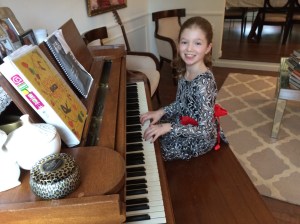
Rina's concert preview

Rina’s concert preview

I have absolutely no expectations of Rina where that baby grand is concerned. After several years in storage (it never fit into our living room décor – and I certainly did not push the matter), my son and daughter-in-law pulled it out, had it rebuilt, moved to their house in Seattle and tuned up. It sounds stupendous. It looks beautiful in their home. Its carries loads of family photos, including one of Granny Tula, on its back, just as it did in Granny’s day. And it has carried the additional freight of family history into the heart of our granddaughter.

Rina’s smile was genuine, I could see that. She loves shining in public, doesn’t feel shy, and has the poise of a girl much older than eight. She is also a loving sweetheart of a sister, daughter, granddaughter. Okay, I can stop now. Her two younger sisters are in the wings, listening. Perhaps they will prefer the violin?

Posted in Family history | Tagged , | 3 Comments

Music Stirs Public Movements and Special Private Moments

Does music play the same role as the visual arts or literature in inspiring social or political action? Listen to “Do You Hear The People Sing” from Les Miserables [press “Skip Ad”!]. We can barely hear the lyrics, but as it escalates, the music thumps deep inside us and stirs us profoundly, whatever our politics.

Les Miserables

Les Miserables

Is it the rhythm in Les Miz that sets us up? Or other elements of the music? Elements such as melody that you can’t get out of your head the rest of the day (the “ear worm”); tempo or pace, which in Les Miz builds gradually; dynamics, loud or soft, also building; and timbre, the character of the young, choral collaboration of voices.

This music, written by Claude-Michel Schönberg, inspired, motivated, and even sustained participants through the inhumane revolutionary bloodbath that followed. Given the extent of relatively peaceful and legal American protests over the years and what they have accomplished – albeit, far from everything – let me go on record as opposing violent, bloody, destructive “revolution.”

What about the protest songs of the 1960s?

Peter, Paul and Mary at the 1963 March on Washington

Peter, Paul and Mary, 1963 March on Washington

Pete Seeger in his prime.

Pete Seeger in his prime

Bob Dylan and Joan Baez

Bob Dylan and Joan Baez


In the 1960s, Peter, Paul and Mary, Pete Seeger, Bob Dylan, and many others composed specifically for peaceful demonstrations, not full-blown revolution. It was difficult to keep protestors out on the streets marching arm in arm with the only goal to change people’s hearts and government policies. Protest songs like “We Shall Overcome” kept people marching and hoping. This kind of song persists in today’s American music, but sadly, less in its public actions. Where is the protest music today?

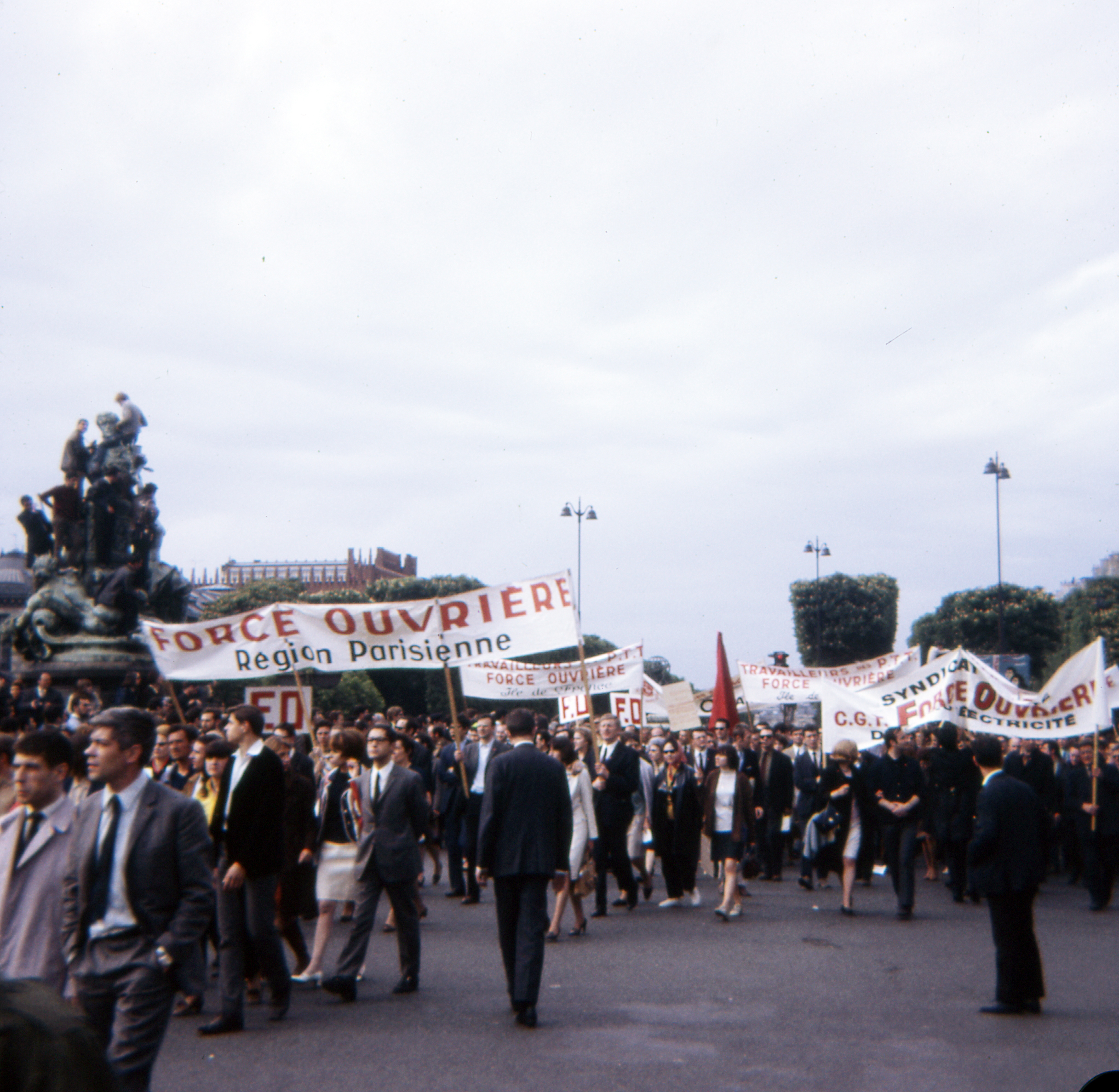
Paris, May Revolution, 1968, Place Denfert Rochereau, where Janet's march began.

Paris, May Revolution, 1968, Place Denfert Rochereau, where Janet’s march began.

Protest songs play a role in The Berkeley Girl, in Paris 1968. Janet Magill’s guitar is with her in both Berkeley and Paris. Janet is also inspired by the 19th century socialist standard, L’Internationale. Here she describes the music’s ability to keep her in the march with her new friends, and in the cause:

Up front, a group had started to sing L’Internationale… The catchy tune flowed back and picked up strength as it rolled our way, until it reached us and we added to its intensity. I still did not know all the words, but I sang la-la to fill in the gaps. We were walking with our arms linked, everyone in high spirits and full of energy, and by the second verse I was singing my la-la’s to the rousing march rhythm in as resonant a voice as my tiny soprano allowed. The full feeling in my chest surprised me. By the second time around I could join in with most of the words, “Debout les damnés de la terre,” I sang. If my friends and I were the damned of the earth and I had been buried my whole life, at least now, as the song commanded, we were rising together, resurrected.

 Music in this writer’s life

I don’t listen to music when I’m writing, though many writers do. I find it distracting. I listen to music as a warm-up before writing, like stretching before exercise. And when I go to live performances, or listen to a favorite CD in my living room, emotions begin to percolate and then ideas and eventually imagery and distinct words flow from an emotional state into my consciousness.

Jay and I go to hear lots of live music, especially jazz and classical. Folk rock and protest songs are only available these days in our album collection. SF Jazz, SF Symphony, Yoshi’s in Oakland, and Café Stritch in San Jose are our favorites, but we get out to many other venues around the Bay Area.

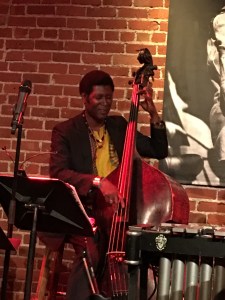
Marcus Shelby

Marcus Shelby. Photo: Jay Miller

Jazz has figured prominently in many of my short stories, including “Playing by the Rules” in Fault Zone: Stepping Up to the Edge (2011), in which our friend Marcus Shelby, a Bay Area jazz composer, bassist and conductor, plays at the Fillmore Jazz Festival.

Marcus’s music is often based on historically significant figures, and his CD “Soul of a Movement” is a tribute to how music impacted MLK Jr. and the whole of the civil rights movement. It is expressive on many levels.


Marcus Shelby quintet at Cafe Stritch, 1916: Dylan Barrows, Sly Rudolf, Joe Warner, Tiffany Austin, and Marcus.

Marcus Shelby quintet at Cafe Stritch, 1916: Dylan Barrows, Sly Rudolf, Joe Warner, Tiffany Austin, and Marcus. Photo: Jay Miller

Anyone open to musical experience can enjoy the kind of private moments I describe above as a writing warm-up or stimuli for ideas and imagery. Recently, at Café Stritch, Marcus’s quintet featured Tiffany Austin, singing the Abbey Lincoln song “What I have Lost.” Tiffany, Marcus, Abbey, and so many others offer up the quiet, passionate and meaningful songs that may inspire – quite forcefully – a revolution in the personal soul.

Posted in activism today, arts inspiring activism, Music and society | Tagged , , , , , , , | Leave a comment

The Radical View – How Art’s Possibilities Changed America (reprise)

[Note: The following is excerpted and updated from my Nov. 2012 blog of the same title–one followed by more readers than any other that year. Please read on to find out why I was inspired to repeat this subject by news of the upcoming “blockbuster” exhibit at the De Young Museum.]

1

Max Beckman

When I studied art history at UC Berkeley, I saw paintings which prophesized doom and hell, from Michelangelo’s The Last Judgement to Hieronymous Bosch’s The Garden of Earthly Delights. In our century, we studied the truly terrifying images of an evil, brutal and oppressive world by Max Beckman, centered around the World War II era.


Ellsworth Kelly

Ellsworth Kelly

But then – we arrived at “contemporary” art. Abstract Expressionism in the 1950s and Minimal and Pop Art in the 1960s left behind social evils and human brutality – just witnessed to an overwhelming degree in the lifetimes of our professors – to focus on art as entertainment and commodity. Wrought in massive scale, like 1950s Cadillacs and Lincolns, they were all “pure” – “art for art’s sake.” Shape, line, scale, color, texture, balance, no “objects.” And they all fetched high prices, embellishing the walls of the newly wealthy and comprising the “investments” of America’s major corporations.

9781937818302-Perfect rev1.inddSo, what should be art’s purpose? To me, the answer is that the real thing can both entertain and enlighten. I attempted that high wire act in The Berkeley Girl in Paris, 1968. The novel describes the lives and characters of college students who are not initially radicals, but who develop new ideas and ways of coping with the social and political conditions of their era. I would like to say I revealed a “truth,” but in the end, art cannot reveal “truth.” It can deliver only a point of view – or significantly, it can open a conversation.
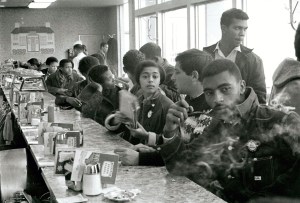
Student Nonviolent Coordinating Committee integrating the lunch counter, 1960s

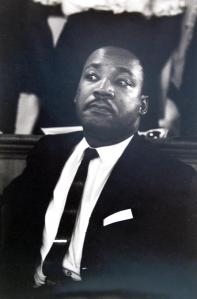
Lyon – Student Nonviolent Coordinating Committee integrating a lunch counter, 1960s; and an unusual view of MLK.

lyon-mlk


That conversation is monumental when the artist is Danny Lyon (b. 1942). November 5 through April 30, 2017, San Francisco’s de Young Museum presents Danny Lyon: Message to the Future, the first comprehensive retrospective of this artist’s career to be presented in 25 years. The 2012 show I wrote about was in a small room, not the main event. Now the De Young will show approximately 175 photographs and related films. Lyon documented social and political issues and the welfare of individuals considered by many to be on the margins of society. Many of the objects have seldom or never been exhibited before. We will also see the artist’s achievements as a filmmaker for the first time.

Lyon’s art is concerned with “…the welfare of individuals considered by many to be on the margins of society” and we are moved to empathy by  “…his ability to find beauty in the starkest reality.”

Tesca, Cartegena, Columbia, 1966

Lyon – Tesca, Cartegena, Columbia, 1966

From the museum website: “…Lyon has distinguished himself by the personal intimacy he establishes with his subjects and the inventiveness of his practice. With his ability to find beauty in the starkest reality, Lyon has … provided a charged alternative to the bland vision of American life often depicted in the mass media.”

Once more back to 1968 – in The Berkeley Girl, I tried to present more than a youthful rebellion. I am not – could not! – compare the hardscrabble, hard-fought life of poverty and racial discrimination portrayed by Danny Lyon with the privileged upbringing of middle class college students in the 1960s. But unlike their parents, many of those students could not ignore those less fortunate and more oppressed than themselves. Their new empathy sometimes made for heart-wrenching conflicts.

Where did this empathy come from? This spirit of empathy in America has continued to expand since the 60s, at least for larger segments of society than ever before in history. I believe that it was greatly fostered by the photographs and artworks by individual artists like Danny Lyon. Their courage and talent helped to spread artistic liberty across America. It also opened the eyes of Americans to the beauty of all humanity, despite the difficult reality beyond our fastened gates.

Posted in Arts and society, arts inspiring activism | Tagged , , , , , , , , , | Leave a comment

Art History for Skeptics

Frank Stella's "rebuilt painting" at the newly-reopened San Francisco Museum of Modern Art

Frank Stella’s “rebuilt painting” at the newly-reopened San Francisco Museum of Modern Art

This blog is dedicated to skeptics. In the preceding blog, I offered specific examples of art which might change minds and inspire action. But what about abstract art, like Picasso’s, or non-objective art, like the constructions of Frank Stella (1936- ) at SFMOMA? What do these, or the many more recent and contemporary abstract and non-objective artists have to contribute to society?

My former art history professors would have argued that art is not about “use” and that only governments of restrictive regimes make that claim.

Instead, I suggest two ways in which these artists can be said to “change minds, inspire action”:

Picasso

Pablo Picasso (1881-1973)

Henri Matisse (1869-1954)

Henri Matisse (1869-1954)

Edvard Munch (1863-1944)

Edvard Munch (1863-1944)


  • Artists like Picasso, Matisse and Munch were vilified when they first veered away from traditional “representational” styles – painting and sculpture which represents what we see, the “real” world. (Note that the term “realistic” art is an oxymoron, since no art can completely imitate nature, it can only “represent”/interpret it). When artists like Impressionist Monet, and later Picasso and Munch, began to “abstract” nature – that is, begin with nature and pull it toward an optical, intellectual abstraction (Picasso), a sensual one (Matisse), or an emotional one (Munch), they were either denigrated or ridiculed in the press.
Piet Mondrian (1872-1944)

Piet Mondrian (1872-1944)

Wassily Kandinsky (1866-1944)

Wassily Kandinsky (1866-1944)

Frank Stella, earlier work (1967)

Frank Stella, earlier work (1967)


Beginning with Piet Mondrian (1872-1944) and Wassily Kandinsky (1866-1944), through Frank Stella and increasingly many other artists today, we have “non-objective” art, which does not begin with nature at all. These artists use elements of art like color, line, shape, and texture to create their works.

Eventually, critics, dealers, collectors and the public began to accept and understand that these were courageous individuals with unique artistic vision. So first, we have artists as rebels, reinventing a world view. In helping us to see the world differently, they let us know that we can, in all realms of personal, social and public interaction, “think outside the box” or even to re-think the box itself. They inform us that it is possible to change things, and they give us an example of how they did it – morally, visually, and professionally.

Picasso's Synthetic Cubism: taking objects apart and reassembling them.

Picasso’s Synthetic Cubism: taking objects apart and reassembling them.

  • Picasso takes apart and reconstructs what he sees, which says to me that he is not making a statement about destroying, but about reconfiguring or realigning. This concept is of tremendous “use” to society. It is a concept which relates to societies and communities in everyday life, as well as science and engineering.

As a visual artist, Picasso broke new ground, just as in literature, authors like Dickens and Twain were the first to make heroes out of street urchins or rascals. They changed our minds about the value of all humans, helped us get to know them and to love them, too. In reconstructing the visual world, artists offer a new kind of beauty, one that is balanced, vivid, dynamic, and ultimately, full of hope.

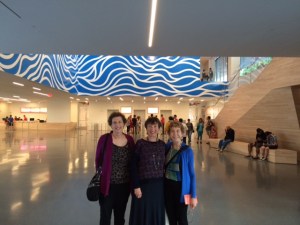
Elise with Helene and Marilyn (the "Proust" readers) at SFMOMA.

Elise with Helene and Marilyn (the “Proust” readers) at SFMOMA.

P.S. If you haven’t yet visited the newly-reopened SFMOMA in downtown San Francisco, plan on more than one visit! The sheer scale of it, the quality of collections, not to mention the lunch and coffee/pastry selections, top any “modern art” museum in the world!


Posted in Arts and society, Purposes of abstract art | Tagged , , , | 5 Comments

Art can change minds, inspire action

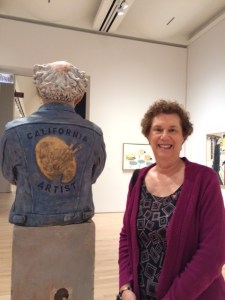
One CA artist is glazed stoneware by Robert Arneson. The other one is real, and obviously enjoying the new SFMOMA.

One CA artist is glazed stoneware by Robert Arneson. The other one is real, and obviously enjoying the new SFMOMA.

During a discussion at the World Fellowship Center, the family camp devoted to social justice, environment, and peace which I attended last month, I heard one decades-long camper complain that she felt the program had become “lightweight.” “We used to be focused on tough progressive lectures and strategy sessions,” she remembered. “Now it’s all arts and crafts.”

At the time, we sat pasting magazine cutouts onto cigar boxes, while my daughter was in the social hall learning to play the ukulele. Who was I to disagree? Yet our week had hosted lectures on how to defeat ISIS without violence and the state of labor unions today. Perhaps I wasn’t the one to judge, since the programs I felt had the most impact were the “fluffy” performances of dance, poetry and music and activities which ranged from memoir readings to, yes, collaging boxes.

My life has been centered on the arts, first as an art history student at UC Berkeley and UCLA, later as an arts teacher, newspaper critic, and magazine columnist. Even as I gradually weaned my way out of the field and into “communications,” I read voraciously, and attended every exhibition, performance and arts offering that I was able to fit into my schedule.

So when my husband Jay attended a Stanford Jazz pre-concert talk within a few days of my return home from World Fellowship, with a startling takeaway that intrigued us both, it gave me pause. Maybe I would disagree with the disgruntled old camper after all!

Buena Vista Social Club AlbumKCSM’s Jesse ‘Chuy’ Varela reflected in his talk that a small-time 1990s recording called the Buena Vista Social Club had influenced the whole course of history. After rising to a popular, 12 million-seller, it spawned a documentary. Following that, Cuba was no longer a forgotten enemy enclave, but the focus of intense interest. People began to look, listen and re-visit the course of history. Jessie drew a direct line between the music and the eventual U.S. recognition of Cuba. Today, our country enjoys relations with our former off-shore nemesis in a number of important areas, and continues to highlight its music.

Occupy poster2I began to remember the role of the arts in the 2011 Occupy Movement, which swept the country through social media and bequeathed the words 99% for Bernie Sanders—and now the entire Democratic party–to use with consequential effect.

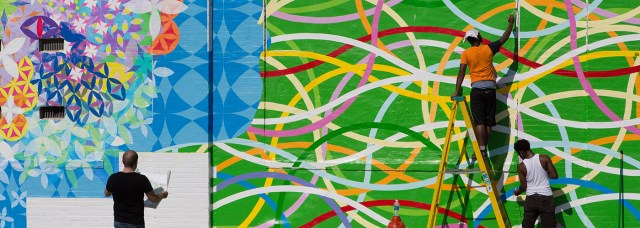
The Occupy Movement in 2011, just as the Paris Revolution depicted in my novel, The Berkeley Girl, in Paris 1968, used the creative expressive power of poster art to gain support. [Select the link to see hundreds of Paris 1968 posters!]

Aug. 2012 -Trump Tower lit by Illuminator! Who knew?

Aug. 2012 -Trump Tower lit by Illuminator! Who knew?

Both historical movements found posters amazingly effective. Occupy posted not only on walls, but online. The performance artist group The Illuminators supplied the Occupy Wall Street protests with citywide images. Their slogans lit up NY buildings and were hits on YouTube.

Phila Mural Arts1When the Democrats went to Philadelphia last week, CBS Sunday Morning produced a segment on Philadelphia which exploded my awareness of the powerful influence of the arts on society. The Philadelphia Mural Arts Program has produced 4000 murals over the past 30 years – and still going strong! Participation as artists and supporters unites a cross-section of the community. Within Mural Arts, The Guild is one of several special programs offering apprenticeships to formerly incarcerated individuals and young adults on probation. Another provides opportunities for incarcerated fathers and their kids to paint together each week. And perhaps most powerful of all, the images themselves influence the way Philadelphians regard their city and their lives every day.
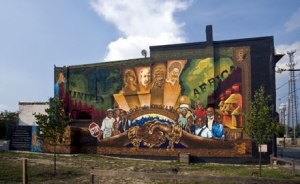
Phila Mural Arts2Not to be left out, the Bay Area has its own similar organization in East Palo Alto, the Mural Music and Arts Project, EPA–Educate, Empower, Inspire Youth through the Arts/.

Besides music and visual arts, literature is an “art” which changes minds and hearts, arguably in a more direct way. To be sure, my novel The Berkeley Girl simply describes my personal version of history. But further, my hope is that the story will inspire readers to speak out or act in whatever way they are comfortable, when they understand how protagonist Janet Magill, a shy and apolitical college freshman, was motivated to do when faced with intolerable injustice.

What visual arts, music, dance, poetry or prose has changed your mind or inspired you to take action? Please “Comment” with the art reference and how it motivated you!

Posted in activism today, arts inspiring activism | Tagged , , , , , , , , , | Leave a comment

How Summer Camp and Social Justice Have Changed!

Elise and Amy on a  summer camp hike.

Elise and Amy on a summer camp hike.

When my daughter Amy suggested a “socialist summer camp” in the White Mountains of New Hampshire for our getaway together, my heart began to race. Would they pontificate around the campfire? Would they be advocating world revolution over the Mac ‘n Cheese? For those of you who have read my novel about college-aged American and French protesters in 1968, you know that Janet McGill of Beverly Hills calls herself a socialist because she “believes in fairness.” But I am not Janet McGill, if anyone should ask you. And as an adult with a keen sense of history, I have written that despite a nonviolent philosophy, Janet’s group found themselves involved in actions which, frankly, frighten me.

Lloyd Lodge frontSo I went to the camp website, where the first thing I saw was their slogan, “Where social justice meets nature.” Founded in 1941 as a non-profit organization, the World Fellowship Center (WFC) is a “camp and conference center with a social conscience.” They are dedicated to all the things I do adhere to: social justice, peace and the environment.

So what was it like? Like nothing I’ve ever experienced! Families have been coming there since their grandparents’ generation. Mostly east coast “lefties” – who now call themselves “progressives.”

Lloyd Lodge out backHere is dinnertime at the WFC, beginning with the view out the large, screened windows. The summer sun flits in and out of storm clouds that have moved in over the large, scraggly lawn. Green Adirondick chairs and 1950s metal lawn chairs are turned this way and that under a red fir tree nearly 100 feet tall.
Howie_dining hall (2)Inside it looks like any other camp dining hall, but here, both the range of ages and table topics are unique.

A young African American poet tries to convince her 1-year-old to take a bite of the thick butternut squash soup, laced with crème fraiche and crisped sage leaves plucked from the camp garden. Two school-aged children have already finished theirs and ask Healthy Menuone of the teenaged staff bustling around the room for a refill. Adults of all ages talk issues and families more than politics, taking their time with their meal. Those who have not been here before try to get to know their tablemates.

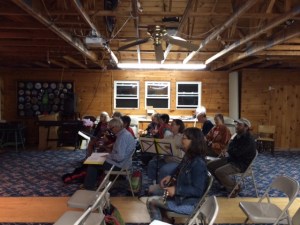
That last would be me. We sat often with another mother-daughter twosome, the mother a public health librarian and the daughter a junior in high school. The family had been coming to the camp since 1961!

Between tents and cottages, we chose the comfortable Uphaus Lodge in this well-run facility.

Between tents and cottages, we chose the comfortable Uphaus Lodge in this well-run facility.

When I try to sort out the scene, my week breaks down into Conversations, Arts and Issues programs/presentations (these two dovetailed nicely), and Nature.

Conversations with the Peace Action retreat folks were both idealistic and strategic. One brave woman not much younger than I am has traveled to Honduras with Witness for Peace, meeting with indigenous peoples who have been forced from ancestral lands by corrupt government officials on the take from corporate loggers.

On hikes and at meals, I spoke with many who are frustrated by the gentrification all up and down the urban east coast, where tech communities are forcing out the middle class and engendering homelessness (sound familiar, San Francisco?). My hiking companions were organized and trying to help on several levels. Other memorable talks were about how a garden failed because of severe climate change. About how the camp has swung toward the role of creative expression and the arts in promoting progressive viewpoints. And of course, the getting-to-know-you conversations about work, kids and grandkids, and – always extremely brief – this week’s rolling political disasters.

The Arts during my week began with an exquisite and emotional program of live contemporary dance, poetry, and music video. This was not in any way amateurish. These professionals teach and perform with their passions in mind. In this case, subjects like mind-body connection, Syrian refugee crisis, and freedom. Maya Angelou’s “We Are All Birds” was read, set to original music, and danced by Kate Griffler, the weeks’ dance counselor. Kate began by crouching and moving intensely while perched atop a high stool. I am so sorry that I did not bring my camera!

My favorite was “Pregnant with Coltrane” written and performed by the young mother I met at dinner, Mariahadessa Ekere Tallie (we called her “ee-kari”). Re-imagining Coltrane’s pregnant mother, fearful and dismayed by the world into which her child would be born, considers destroying him. But the child himself, eager to experience the joy of life, and ultimately, like his mother, to create, wills himself into existence. And then there was Coltrane…right? I bought one of Ekere’s two published books, and everything she writes is just as dazzling, just as heartfelt.

Ukelele workshop and singalong

Ukelele workshop and singalong

It was also “ukulele” week, and besides programs to learn the instrument (Amy is now a fan), there were two others to describe the history of the instrument and to relate how important music has been in the education of young progressives. I also learned about the “Commie Camps” of the 1930s through the McCarthy era, and how children from those camps eventually detached themselves from Communism and became the active progressives of today. On two days, Amy and I worked on the screened porch that wrapped around the main lodge, making “collaged boxes” (i.e. cutting magazine photos to paste and seal onto cigar boxes…) and listening to the ukulele group strumming and singing Dylan, Seeger and many other favorites from the 1960s.

Whitton Pond - really a  lake - a good place to daydream.

Whitton Pond – really a lake – a good place to daydream.

The property has a pond which is really a good-sized lake. So we hiked the one-half mile trail over there a couple of times, and Amy did the triathlon of hike/swim/kayak. They also had rowboats and canoes, and she offered to take me out, but I preferred to sit on one of the comfortable benches onshore and just revel in the scenery.

Besides Edie, the arts “counselor,” the camp had a high school science teacher who led biking and hiking trips every day.


Amy, Sabbaday Falls

Amy, Sabbaday Falls

We hiked local trails to Sabbaday Falls to see the basalt-in-granite formations, to Rocky Gorge and pond, and to the Bolles Reserve. We learned what an esker was—and climbed it. Along the way, we picked from the abundant blueberries in a vast meadow, where on the return hike, we were drenched by a cloudburst.

Amy is a political organizer and promoter of progressive issues in the greater New York area, with a particular focus on climate change. Amy and I took the time for long talks, easily the most meaningful part of the trip. I learned much more about her life and enjoyed “qvelling” because she’s a good person, living off the straight and secure path all we suburban moms and dads envision for our children, but clearly making genuine contributions to our world, and enjoying her life along the way.

Elise, Sabbaday Falls

Elise, Sabbaday Falls

I come from a long line—on both sides—of capitalists. They felt that America could do no wrong, and the Commies were trying to turn our country into Russia. They believed in civil rights, gun control, science, and “choice.” But they were old-style Republicans. They hated taxes and unions and the Reds. Women’s rights, were not included in civil rights. And there was no LGBT. I grew up with a set of political categories that I have to struggle to remember, because today they are completely transformed.

The central take-away from the WFC camp is to put my late 1960s definition of “radical” and “left wing” into historical perspective. To hear stories of one whose father fought with the Communists in the 1937 Spanish Civil War; of the camp director who was jailed at 70 years old because he wouldn’t give Senator McCarthy complete lists of the men, women and children who had ever been WFC campers; of the dangers of civil rights efforts in the 1940s and 1950s, way before MLK became a household word.

Picking blueberries on Bolles Preserve hike

Picking blueberries on Bolles Preserve hike

On the hopeful side, I met people involved in a range of organizations who work on behalf of children, disadvantaged groups, refugees, our climate and our planet, prison populations, homeless families, and on and on. I don’t lionize old-style Communists, nor do I admire the big-talking “liberals” that I considered to be the adults on the right side of history when I was in college and in the 1970s. But the WFC crowd did not and do not just talk, they act. In daily, individual and group micro- and macro-actions, within the framework of our nation, they are trying to change things to match their vision of the true democracy we were meant to be.


Posted in activism today, progressives at summer camp, Writing fiction | Tagged , , , , , , , | 4 Comments

Transitions

Unity and growth

Unity and growth – love this image!

Welcome to my new combined website and blog! For years these two have lived at two separate addresses, and the two dwellings felt disconcertingly like the workplace and “home.” Now the two are one, the url/address is one, and I feel much more centered.

This is my first blog on my new WordPress Premium site! Why blog at all, you may ask? Today, to be a published author, one needs a website, a blog, a presence on a broad array of social media. There are days when all authors (at least the many I have come to know!) resent the time it takes to engage in “marketing” – time no longer available for the activity we love best, writing! Yet, blogging brings marketing and writing together – because it is writing! The fiction stories and novels and the blogging go together, support each other, and keep me thinking critically about my writing choices and crafting written pieces that deal with real life.

"Woodstock" typewriter - really?

A “Woodstock” typewriter – really?

I hope to carry you right along with me, to acquaint you with my choices, my process, related research and travels, and influences from society, politics, arts and music. Writing blogs helps me reach out to readers in between my larger – and long-longer-longest – projects!

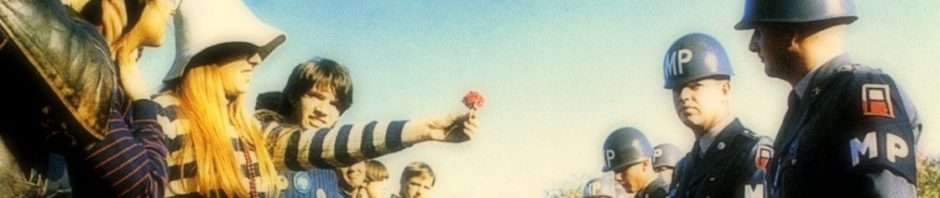
Please take a few moments to run through the website menu selections beneath the header of the protester offering a flower to a policeman. Much on the new website was adapted from my old site, but there are a few new aspects, and there will be more to come.

Header

Header

The header is connected through general themes of the insanity of war and the healing power of love, themes found in my re-released novel, The Berkeley Girl, in Paris 1968 (Sand Hill Review Press). Is the girl pictured in the header a “flower child” of the 60s? Or is she an ordinary girl, struggling to live, laugh and love during an extraordinary time?

Besides further discussion of topics related to the history and relevance of The Berkeley Girl, both the website and the blog will preview upcoming publications:

  • A sequel to The Berkeley Girl, just completed and currently being edited. More about that to come – as well as sneak peeks into its pages and the opportunity to weigh in on certain aspects!
  • Short fiction and novels about America’s immigrant generation during the late 19th and early 20th After three years of research into my family history, I am now beginning to wrap up the tumultuous, pivotal “60s” and turn my attention to these earlier, remarkable stories. Stay tuned!

Thank you for reading this far, and for being supportive of my dream to write about things I care about! Also, please note and bookmark the change in the address to elisefrancesmiller.com/.


Posted in About the blogs, Writing fiction | Tagged , , , , , , , | 7 Comments

Summer 2016 News about my Berkeley to Paris 1968 Novel

Dear Friends,

Please take a look at this book cover. Many of you have already read it, and some of you have even written reviews on Amazon.Stones FrontCover I am writing to tell you some exciting news – and also to warn you!
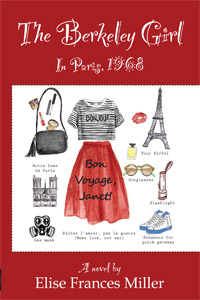
I am grateful that my publisher, Tory Hartmann of Sand Hill Review Press, believes in this novel enough to re-release it with a new cover and title. Perhaps you have seen the Sand Hill Review Press Facebook Page, which includes the new version of the novel, now called The Berkeley Girl.

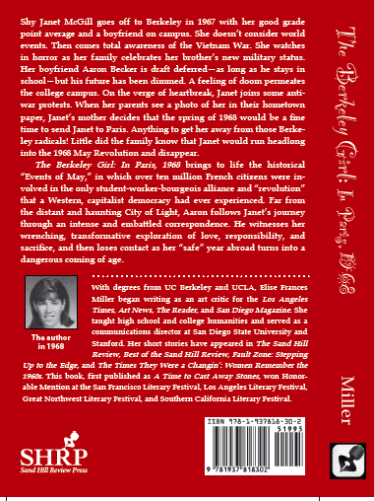
The Berkeley Girl is the same book as A Time to Cast Away Stones, with a new cove9781937818302-Perfect rev1.inddr and title. If you have read it,  this may be an opportunity for you to renew your acquaintance with the story and characters, or you may have friends or relations for whom you’d like to purchase a copy.

This month, I will be at the Bay Area Book Festival at the SHRP booth and also at the California Writers Club booth, and would love to chat about the book – or any beloved books! – so please come visit me. The Festival, June 4th and 5th all day, is going to be a wonderful event for book lovers of all ages – to find out more, visit http://www.baybookfest.org/

Then, please come greet over 25 authors during Authors’ Day on Sat., June 18, 2-4 pm, at the San Mateo County Fair Literary Stage. Also at the Fair, on Sunday, June 12 at 1 pm, I will be on a  panel of four great novelists called “Writing Historical Fiction.” For a complete schedule of events, see https://www.sanmateocountyfair.com/contests/departments/literary-arts

Here is the rationale for changing the cover and title: In speaking to various groups when “Stones” was launched in 2012, comments at colleges and in younger reading groups indicated that they often thought the book was about World War II! Even though the words “Paris, 1968” were on the cover, and this is an archival photo from the Paris May Revolution, younger readers were not familiar enough with the era or its history to recognize the cover – nor the title taken from The Byrds’ 1968 classic hit, written by Pete Seeger!

The irony is that one reason I wrote this particular story and set of characters was to debunk 60s stereotypes. Our generation was not instantly catapulted into tie dye and love beads. We lived the cultural, social and style changes, making our own adjustments as we went along.Back Cover screen shot

I thought you might also like to see the back cover with my 1968 photo from the UC Berkeley yearbook.

Finally, please consider writing a review on Amazon – just a couple of sentences – now in support of The Berkeley Girl. Here are a few of my favorite reviews from the earlier version.

“Readers [will] know without doubt that Elise Frances Miller was at UCB and in Paris during the tumultuous 60s. There’s an authenticity to her descriptions of rallies and student protests in Berkeley and in Paris…”  -Nancy Woody, novelist

“I had such great time reading this book. Having lived through the campus unrest of the late 60s it caused me to reflect back to my time at the University of Wisconsin… The character development was exceptional, as was the way the author wove together the political unrest of UC Berkeley, Paris and behind the iron curtain. For anyone who lived through the late 60s (or had parents who did) and wrestled with the anti war and military draft issues, it is a must read book. In addition to being very entertaining, it continually presents thoroughly researched historical facts. The reader should be prepared for a number of surprises not the least of which is a great ending.”  Jim Nantell, former city manager, Burlingame, CA

“… a realistic and passionate ride through the Berkeley protests to the violent protests in France. I learned so much about that time… I enjoyed living in France through Janet Magill and was intrigued by her growth, the dangerous adventures and the discoveries of a young woman coming of age. I will miss Janet and Aaron!”  -Maurine Killough, author and poet

Posted in Uncategorized | Leave a comment

Lessons and Friendships Enable My Writing Life

In a recent and rare Facebook post, I told my friends that this summer has been a “watershed in my writing life.” I decided to elaborate. This is about my Bay Area literary associations – along with plugging away at my computer many hours, many years, they have been at the heart of that life.

Ansary, West of Kabul, East of New York

Ansary, West of Kabul, East of New York

Ansary, Games Without Rules: The Often-Interrupted History of Afghanistan

Ansary, Games Without Rules: The Often-Interrupted History of Afghanistan

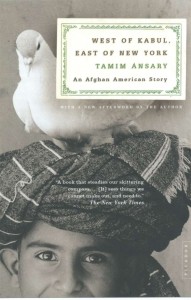
Tamim Ansary has been a valued mentor and friend since 1999, when I began to attend the weekly 2-hour critique sessions, the San Francisco Writers Workshop. This month, after his 22 years as group organizer and leader, Tamim stepped down—a loss that cannot be overestimated in the literary life of San Francisco. SFWW, which claims to be “the oldest continuous running workshop in the U.S., meeting weekly since 1948,” met then at the Meridian Gallery, a city-sponsored artists’ cooperative downtown on Sutter St., and stayed with the Gallery even when they moved to Powell St. After each session, we hung out for an hour or so at Lefty O’Doul’s, a huge, slightly seedy venue with questionable buffet food, gooey pie and any drink you could crave by nine on a Tuesday night. Over a year ago, SFWW switched to The Alley Cat bookstore on 24th.

Throughout all that, Tamim held us together. Like many writers, I came for several years, cut out for a year, returned for another, and so forth over fifteen years, depending on writing projects and the demands of my day job. New faces and old friends always greeted me every time I dropped in from a hiatus, and Tamim was the touchstone, always there. When no one else “got” my work, Tamim always did, and never failed to make the most insightful and constructive comments. Many will miss him and call him “friend,” and even though the last time I attended was a year ago now, I will miss him. In July, I attended his final “Writers’ Tea,” a Workshop tradition he created in his home, usually during the summer and the Dec. holiday season. Tamim and his wife Debbie Krant were gracious hosts to a community of writers of all levels of skill and accomplishment. They both respected the effort and the results, but most of all, the intention and the will.

As a writer of fiction, memoir, essays, articles, children’s books, and nonfiction texts, Tamim offered a stellar example of what a writer’s style, work and life might become. From his own website (http://mirtamimansary.com/): ”Winner of the 2011 Lifetime Achievement Award from the Northern California Booksellers Association, Tamim Ansary is an author whose many books include Destiny Disrupted, Games Without Rules, The Widow’s Husband, and West of Kabul, East of New York.” 

Although I may occasionally drop in to Alley Cat Books to see what is being read, I realized last year that for me, the format and the group had run its course. I was looking for a critique group closer to home, but may just rely on writer/editor friends whose own work I have critiqued or edited, or online “Beta testing,” as so many authors do now.

CWC and WNBA activities dovetail! “Women Writing about the 1960s and 1970s” panel at the Literary Arts Stage, San Mateo County Fair: (l to r) authors Sue Barizon, Marianne Goldsmith, Lynn Sunday, Darlene Frank, and I am the moderator, standing.

CWC and WNBA activities dovetail! “Women Writing about the 1960s and 1970s” panel at the Literary Arts Stage, San Mateo County Fair: (l to r) authors Sue Barizon, Marianne Goldsmith, Lynn Sunday, Darlene Frank, and I am the moderator, standing.

Which brings me to other summer “watershed” events. After five years, I have stepped down from my position as Membership Chair of the California Writers Club, San Francisco/Peninsula branch. CWC has been a major part of my life since just before I retired from Stanford’s Haas Center for Public Service in 2008. Its meetings are monthly, and since becoming a board member in 2011, I have made friends and exchanged services/skills with other members; volunteered at their annual project , mounting the Literary Arts Stage at the San Mateo County Fair; published in many issues of the two journals associated with the club, The Sand Hill Review, published by member Martin Sorenson, and the Fault Zone series, the club’s own anthology; attended and learned about craft, marketing and publishing from monthly speakers; read, listened and learned at the monthly Open Mic; watched as the club developed a website, e-newsletter, and Facebook page; and served as Membership Chair, encouraging new members with our slogan, Writers Helping Writers. In 2011, having done most of that, I received a phone call from CWC past president, Tory Hartmann, who was about to launch her independent publishing company, Sand Hill Review Press. She wanted to read my novel with an eye toward publication. Now Tory has lent her extraordinary range of skills, energy, and enthusiasm to her full-fledged operation (https://www.sandhillreviewpress.com/). I am proud that mine was her first novel, and that I am now one of a “stable” of many SHRP authors.

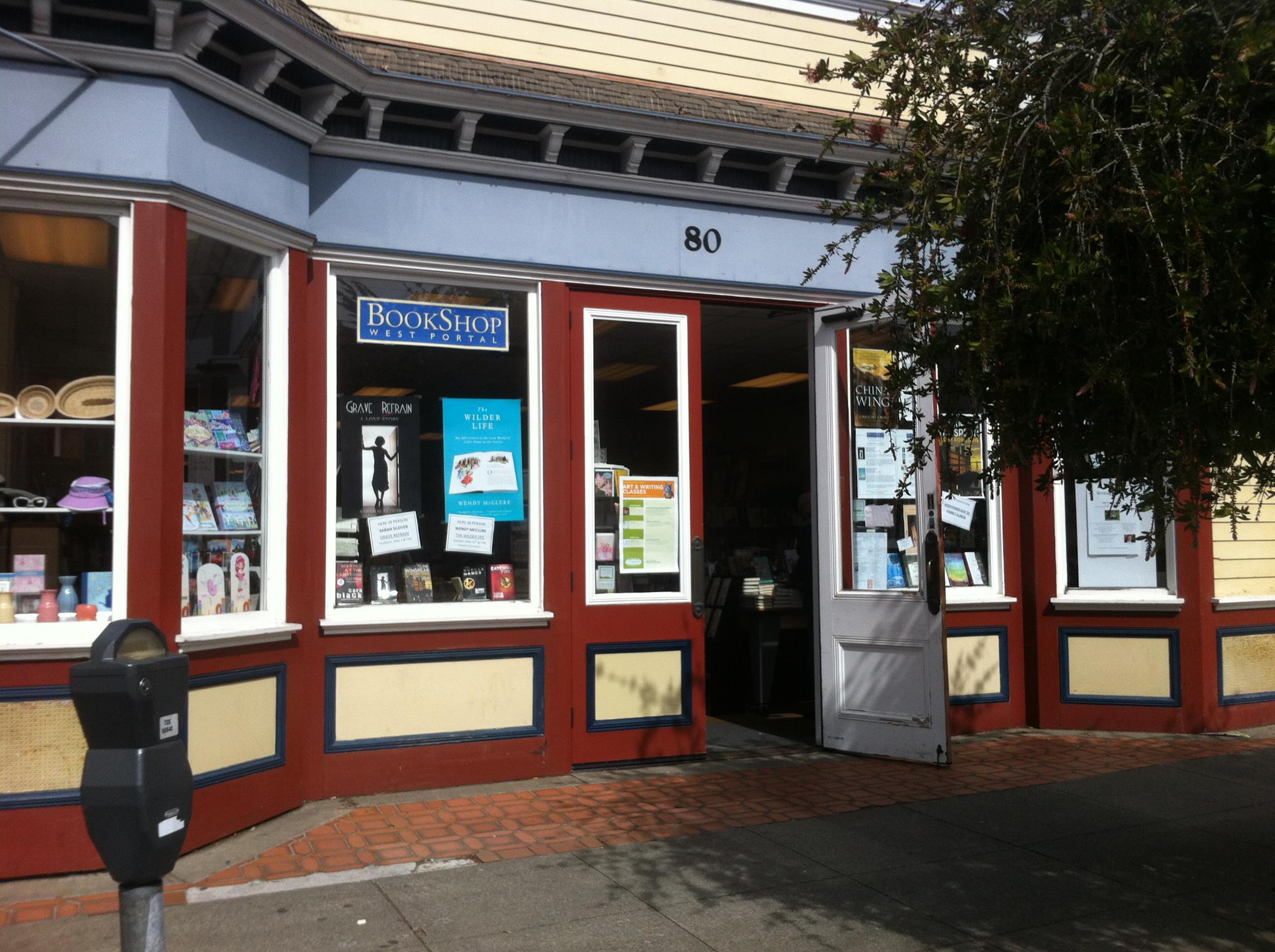
West Portal Bookshop, enjoy the WNBA panel, Oct. 29th!

Join us for the WNBA panel at West Portal Bookshop, Oct. 29th!

Two other groups I have benefited from are the Historical Novel Society and the Womens National Book Association, NorCal chapter (http://wnba-sfchapter.org/). The WNBA, under the superb leadership of Kate Farrell, who published my work in The Times They Were A-Changing: Women Write About the 60s and 70s, focuses on service in the arena of literacy/writing/literature. I hope to increase my involvement in this group as time goes on. If you are in the area, please join us on October 29 at 7 pm at West Portal Bookshop in San Francisco, where I will moderate a WNBA panel of women authors who have written the stories of pointedly adventurous and courageous women. I am honored to present their work.

My final group is the Historical Novel Society, Northern California chapter (https://historicalnovelsociety.org/), meeting quarterly and co-founded by my good friend and a talented historical novelist, Mary F. Burns (http://www.maryfburns.com/). Many have asked me to define “historical fiction,” and have wondered why the spinner of tales about the late 1960s considers herself an “historical novelist.” My first answer is that, although I lived through that period, it was necessary for me to carry out the same kind of painstaking and endlessly involving history that a novelist writing about the Renaissance would conduct! And that then, from this research and my own imagination, the tale is woven. Same process.

Great-aunt Bessie Kantor Greenberg in elegant attire, Milwaukee, c. 1897. She was like one of the “kids” on our trip to Disneyland in 1957!

But another reply would be in my hopes and plans. For the past three years, in between visits to Seattle to my wonderful son and daughter-in-law and our three grandchildren, and New York to visit my dynamic daughter, I have been researching my family history in-depth and documented on Ancestry.com and JewishGenealogy.com. I am fortunate enough to be able to bounce ideas off my friend and cousin, Janie Tyre-Karp, whose genealogical discoveries have been a steady influence and encouragement. I find inspiration in the immigrant tales of family loyalty, tenacity, and creativity. I look forward to the long project of writing non-fiction essays for my grandchildren, and then weaving readable historical fiction out of the amazing threads contained in this material.

The effort to maintain focus in two such different areas, the late 1960s and 19th-early 20th centuries, is mitigated by the relief each brings to the intensity of the other. Everything takes longer, but I am moving forward. And I am grateful, because none of my blessed writing life would have been possible without every one of these organizations. In this watershed summer, the “group activity” may change or fall away, but the support, comraderie, intention, motivation and the work itself, continue.

Posted in Uncategorized | Tagged , , , , , | Leave a comment

Free speech in France – today and yesterday

920x920_Turnley

Peter Turnley’s photo, freedom for all generations in Paris

A VIDEO OF THE PICTURES AND WORDS OF PETER TURNLEY:

http://edition.cnn.com/videos/world/2015/01/12/cnni-holmes-intv-turnley-images-of-paris.cnn-peter-turnley

Please watch this amazing (and quick) video! There is not much more that I can add to the emotional video recording by photographer Peter Turnley, whose images of Paris – coincidentally – were on view last month at the Leica Gallery in downtown San Francisco. Turnley, who has had 43 covers on Newsweek from around the world, has lived half his adult life in Paris and attended the recent demonstration of Parisians and world leaders of over a million people (four million worldwide).

Like Turnley and so many others, I was thrilled to see the French spirit, the national character and values which I witnessed in May 1968, alive in this tremendous outpouring of support for mutual respect and free speech. Amazing to realize that the young lycée (high school) and college students who protested during the “May Revolution” are today the elders of France, the World War II bumper crop now in their 60s! I see those faces mixed in with a current young generation of all ethnicities, all French, in Turnley’s photos, and am reassured that they understand we can never take individual freedom and “free speech” for granted. America and France stand together for those values.

Stones FrontCoverBelow is a scene from my novel, A Time to Cast Away Stones (Sand Hill Review Press). This scene and my own two photos depict the huge, peaceful manifestation (demonstration) during the 1968 May Revolution. This event was the first revolution following World War II in a democratic, capitalist state. Free speech was a central issue, because it began when the students were prevented from assembling and speaking on the issue of the Vietnam War – and at the time, the government of Charles DeGaulle controlled all major media in France. In this scene, Janet Magill, a nineteen-year-old American girl studying in France and participating in the street protests, stands with her Czech boyfriend Teo (Czech was a Communist dictatorship in those days!) and observes the marchers.

blog_Paris68-march_farshotManifestation, I realized, was an apt word in English as well. The event was a physical manifestation that ten million French people had stayed home from work, en grève—on strike: all forms of power, water, transportation and communications would be affected. Factories and mills were quiet, tourists stranded, garbage rotting in the streets. Even entertainers were on strike. Television and radio would carry only the news. From radio reports, we knew that even greater numbers were marching over from the Right Bank, then down Boul’ blog_Paris68-Workers PowerMich’. On Port-Royal, the tremendous,controlled throng formed a torrential tributary heading toward the corner of Montparnasse to meet up with others and further expand the stream. I was mesmerized by the scale of the march, often dozens abreast, and they just kept coming. I marveled at the control, given the numbers. A half million? A million or more? All of Paris? All of France? And such an odd alliance: workers, intellectuals, housewives with their children, men in business suits. All types and ages, many carrying colorful banners or flags, all there to support a gang of college student protesters…”

“What’s wrong, Teo?” I asked. He moved up to slip between Elizabeth and me. “Not a thing,” he said, staring into the crowd of marchers. “It’s … it’s powerful. They are so orderly and controlled. Yet so many of them, free in expressing their various opinions. Something quite beautiful, don’t you agree? Merveilleux.”

Posted in Uncategorized | Tagged , , , , , , | Leave a comment